
On a Jackie Evancho forum I was talking about the need for her to perform songs that exploited her range. I said:
Giving a songwriter Jackie to work with would be like giving a violinist a Stradivarius to play.
It is a double-edged bow, though. A song that fully exploits the "instrument" that is Jackie--from a songwriter's POV--would be a song few others could sing, whereas if they write a great one-octave song with catchy hooks and the like, a million singers could perform it.
But the songwriters Team E wants are the songwriters who want to write for the Stradivarius.
Then a fan said he didn't see why Jackie had to avoid the normal one-octave song (and most songs are pretty much one-octave songs) and only sing song that exploited her whole range every time. This was in response to me talking about the need for her to do wide-range songs. My reply:
I don't understand the logic of requiring that everything she does show off everything she can do, either. That's why I didn't say that.
Mariah Carey is a good comparison, since she has--or at least had--a very wide range, like Jackie. And I don't think all her songs always show off all she can do...just the ones we remember. Just the ones that set her apart.
I said that the Lion King song (that she sang for the PBS Capitol 4th celebration on the 4th of July 2013, and which isn't a wide-ranging song) was probably appropriate for the occasion, and that something like Nessun Dorma wouldn't have been.
At the same time, Jackie fans should understand that it didn't distinguish her as much as a more fully Jackie-exploiting song would have done. This fact isn't incompatible with accepting the limitations of the occasion.
"To make the best of life as it is--and as it can be made to be."
As for what's "the most important," it's true that I've heard plenty of wide-range songs that weren't good songs, and a lot of one-octave pop songs that were.
But if Jackie's next three albums comprised nothing but one-octave songs--no matter how well-written and Jackie-appropriate they were otherwise--it would be like seeing a concert on the loveliest grand piano on Earth, played by the best piano player, but where the whole concert only used, eight of its 88 keys.
I can't believe any of Jackie's fans have such a tin ear that they'd find that acceptable.
Saturday, August 10, 2013


re: practicing one's art, using Jackie Evancho as an example
A Jackie Evancho fan said: "If they need a tremendous amount of practicing to play a difficult technical piece then they aren't a prodigy."
I replied:
Yessish...but we have to acknowledge that out of all the singing that's out there, Jackie performs within a very narrow range.
I've no doubt that she could quickly master, say, Villa-Lobos' "Bachianas Brasileiras" (Western classical), or "Summertime" from Gershwin's light opera "Porgy and Bess." Or anything from the American Songbook--anything.
But I'm equally sure that even if the Queen of Night's big aria from "Magic Flute" were pitched down to a mezzo range, Jackie couldn't do it with her current chops. I've no doubt that she could figure out how to do it at some point of course.
With a lot of study/training, though. (That is, even if she could pick it up by herself without instruction, she'd still need to put in many hours of work to get there.)
I could name dozens of songs that she also couldn't pick up without a whole lotta work. Tom Lehrer's "The Elements," in which the singer has to rattle off the names of all the element in the Periodic Table (as of 1960) to a Gilbert and Sullivan patter song tune--with a light, jovial tone. Screamin' Jay Hawkins' crazed, bluesy "I put a spell on you." Annie Ross's Mach 5-velocity part of the Lambert Hendricks & Ross jazz classic trio "Airigin." The ferocious "Marat/Sade" that Judy Collins nailed in one of her early albums. Janis Joplin's Dionysian war cry "Ball and Chain" as she did it live at the Monterey Pop Festival.
And that's all Western music that uses the familiar Western tempered scale. She's probably never even heard anything like "Kalimankou Denkou (The Evening Gathering)" ( http://www.youtube.com/watch?v=SD83L4kI3q
This is a slow song, like Jackie likes. And it doesn't require a big range. But if you listen closely, you'll see that the sound-shaping is extremely sophisticated and like nothing in the Western music Jackie's familiar with. Ditto many of the harmonies with the chorus. And it's not just exotic. I find the piece profoundly moving...poignant and evocative of the Balkan mountains it comes from.
Or the exquisite ghazal "Yuhn na thi" ("My love and I were not destined to be together in this life"), as sung by the queen of Indian Classical Crossover (as it exists there), Asha Bosle ( http://www.youtube.com/watch?v=_VTT9TqjK2
It is, again, a slow song (like all ghazals), without a wide range. And again I guarantee you that as brilliant a musician as Jackie is, it would take her a looong time to learn how to sing this competently.
There are two Jackie Evanchos: the musical interpretive genius (MIG-Jackie) and the normal 13 year old girl (N13-Jackie). Her parents are obviously fully committed to nurturing both Jackies.
This interferes with the amount of practice MIG-Jackie needs to get to the next level. Meanwhile N13-Jackie reasonably argues that she's packing them in at this level of attainment and there's the trampoline and the pool and her friends.
My proposed solution is to expose Jackie to a wider variety of music. She needs to know what's really out there. And that might inspire her, help her see where she wants to take her musical life.
I have no idea where that is, apart from thinking that doing something to get more 18-35 year olds into her audiences--something that also satisfies her musically--could easily become a priority for her out of all her options.
She might also feel a little constrained about experimenting when doing what she's now doing is supporting her household. Here again I have no idea whether this enters into her calculations. It's just a possibility.
I replied:
Yessish...but we have to acknowledge that out of all the singing that's out there, Jackie performs within a very narrow range.
I've no doubt that she could quickly master, say, Villa-Lobos' "Bachianas Brasileiras" (Western classical), or "Summertime" from Gershwin's light opera "Porgy and Bess." Or anything from the American Songbook--anything.
But I'm equally sure that even if the Queen of Night's big aria from "Magic Flute" were pitched down to a mezzo range, Jackie couldn't do it with her current chops. I've no doubt that she could figure out how to do it at some point of course.
With a lot of study/training, though. (That is, even if she could pick it up by herself without instruction, she'd still need to put in many hours of work to get there.)
I could name dozens of songs that she also couldn't pick up without a whole lotta work. Tom Lehrer's "The Elements," in which the singer has to rattle off the names of all the element in the Periodic Table (as of 1960) to a Gilbert and Sullivan patter song tune--with a light, jovial tone. Screamin' Jay Hawkins' crazed, bluesy "I put a spell on you." Annie Ross's Mach 5-velocity part of the Lambert Hendricks & Ross jazz classic trio "Airigin." The ferocious "Marat/Sade" that Judy Collins nailed in one of her early albums. Janis Joplin's Dionysian war cry "Ball and Chain" as she did it live at the Monterey Pop Festival.
And that's all Western music that uses the familiar Western tempered scale. She's probably never even heard anything like "Kalimankou Denkou (The Evening Gathering)" ( http://www.youtube.com/watch?v=SD83L4kI3q
This is a slow song, like Jackie likes. And it doesn't require a big range. But if you listen closely, you'll see that the sound-shaping is extremely sophisticated and like nothing in the Western music Jackie's familiar with. Ditto many of the harmonies with the chorus. And it's not just exotic. I find the piece profoundly moving...poignant and evocative of the Balkan mountains it comes from.
Or the exquisite ghazal "Yuhn na thi" ("My love and I were not destined to be together in this life"), as sung by the queen of Indian Classical Crossover (as it exists there), Asha Bosle ( http://www.youtube.com/watch?v=_VTT9TqjK2
It is, again, a slow song (like all ghazals), without a wide range. And again I guarantee you that as brilliant a musician as Jackie is, it would take her a looong time to learn how to sing this competently.
There are two Jackie Evanchos: the musical interpretive genius (MIG-Jackie) and the normal 13 year old girl (N13-Jackie). Her parents are obviously fully committed to nurturing both Jackies.
This interferes with the amount of practice MIG-Jackie needs to get to the next level. Meanwhile N13-Jackie reasonably argues that she's packing them in at this level of attainment and there's the trampoline and the pool and her friends.
My proposed solution is to expose Jackie to a wider variety of music. She needs to know what's really out there. And that might inspire her, help her see where she wants to take her musical life.
I have no idea where that is, apart from thinking that doing something to get more 18-35 year olds into her audiences--something that also satisfies her musically--could easily become a priority for her out of all her options.
She might also feel a little constrained about experimenting when doing what she's now doing is supporting her household. Here again I have no idea whether this enters into her calculations. It's just a possibility.
re: Classical music at church
re: classical music at church
I understand that many, many churches now use "Christian rock" / "Praise music" instead of hymns. Most of it is pallid feel-good stuff I can't stand. At least the equivalent that the black Gospel churches do is interesting to listen to.
The Mormon church still uses mostly 4-part hymns with a hymnal and an organ accompaniment, so people can listen to at least quasi-classical music and work on their part singing. At least half the hymns are stodgy old-timey songs but the other half is pretty good--there's even one harmonization by Bach, and some gorgeous Thanksgiving hymns dating back to the 17th century.
On the other hand, I attended a Catholic funeral a few months ago and the music comprised us all listening to a soloist accompanying himself on a guitar. Our job was just to sit there passively. And the music was "modern" Praise stuff. It wasn't bad, I have to admit, but I missed the "audience participation" element.
In the 19th century all the churches had good stuff--lots of songs about Death and our Eternal Reward or Punishment. They got serious. But now that death has gotten so less frequent and so more explicable, church music--even in mainstream Protestant churches--has gotten to be more what I'd call Happy Face music.
Fooey.
I understand that many, many churches now use "Christian rock" / "Praise music" instead of hymns. Most of it is pallid feel-good stuff I can't stand. At least the equivalent that the black Gospel churches do is interesting to listen to.
The Mormon church still uses mostly 4-part hymns with a hymnal and an organ accompaniment, so people can listen to at least quasi-classical music and work on their part singing. At least half the hymns are stodgy old-timey songs but the other half is pretty good--there's even one harmonization by Bach, and some gorgeous Thanksgiving hymns dating back to the 17th century.
On the other hand, I attended a Catholic funeral a few months ago and the music comprised us all listening to a soloist accompanying himself on a guitar. Our job was just to sit there passively. And the music was "modern" Praise stuff. It wasn't bad, I have to admit, but I missed the "audience participation" element.
In the 19th century all the churches had good stuff--lots of songs about Death and our Eternal Reward or Punishment. They got serious. But now that death has gotten so less frequent and so more explicable, church music--even in mainstream Protestant churches--has gotten to be more what I'd call Happy Face music.
Fooey.
Friday, August 9, 2013
Is Jackie Evancho a prodigy?
A prodigy is someone who exhibits some kind of skill(s) considerably earlier than most other people do.
A genius is someone who exhibits some kind of skill(s) that most other people can't do regardless of their age/training/experience.
You can be a prodigy but not a genius, a genius but not a prodigy, or both.
And if you are a genius, it might be in just a narrow area--or in several--or in many--leaving you pretty normal otherwise.
I believe Jackie is both in the area of vocal interpretation of Classical Crossover music. She seems quite intelligent in other areas, but hasn't demonstrated actual genius elsewhere. She strikes me as a genius in this specific area because I think she does what she does better than any adult I've heard--not in every single aspect of CC singing, but overall.
Seems like a lot of singers who are also quite intelligent develop several areas, as did, for example, Linda Ronstadt (pop/rock, light opera, Mexican traditional) and Renee Fleming (opera, jazzy pop).
So here's a question--if Jackie goes that way and develops a second area besides CC, what do you suppose it will be?
A genius is someone who exhibits some kind of skill(s) that most other people can't do regardless of their age/training/experience.
You can be a prodigy but not a genius, a genius but not a prodigy, or both.
And if you are a genius, it might be in just a narrow area--or in several--or in many--leaving you pretty normal otherwise.
I believe Jackie is both in the area of vocal interpretation of Classical Crossover music. She seems quite intelligent in other areas, but hasn't demonstrated actual genius elsewhere. She strikes me as a genius in this specific area because I think she does what she does better than any adult I've heard--not in every single aspect of CC singing, but overall.
Seems like a lot of singers who are also quite intelligent develop several areas, as did, for example, Linda Ronstadt (pop/rock, light opera, Mexican traditional) and Renee Fleming (opera, jazzy pop).
So here's a question--if Jackie goes that way and develops a second area besides CC, what do you suppose it will be?
Are gifted kids' parents always gifted? Are Jackie Evancho's?
On a Jackie Evancho fan forum I once said "when her mother speaks for her I listen, but reserve judgment."
Jackie Evancho's mother Lisa is revered by nearly all of Jackie's fans, so I felt constrained to explain that reservation:
Because parents don't always know everything about their kids. None of us are omniscient. When I was teaching gifted students I belonged to the California Association for the Gifted (a support group), and one study I saw compared the assessment of teachers, parents, and test on evaluating whether their kids were gifted.
Teachers came in at about 50%--mostly because, I think, they couldn't tell the difference between docility and intelligence, or between unruliness and stupidity. Bright kids forced to plod along at the pace of the rest get bored, and many then start making trouble for the teachers.
And parents? Off the top of my head I recall them coming in at around 2/3 to 3/4. Meaning a substantial number of them didn't realize their kid was gifted. Mike E said honestly that he and Lisa didn't realize Jackie was gifted until the grandparents and the stunned audiences at local performances told them otherwise.
When you're a parent it's tough to be objective. You want so much for your kid...or you get involved in power struggles with your kid...or you try to get a do-over for your own thwarted dreams with your kid...or you see your kids at a reflection of and on you rather than seeing your kid for who he is.
Having kids is humbling. So much of who they are was set in stone at the moment of conception, and more was locked in long before they could even start talking.
Lisa said a number of things that gave me high hopes for the parents' parenting of Jackie. That Lisa believed kids shouldn't be totally insulated from the harsh realities of life. That she wanted to support Jackie's childhood AND her aspirations. That she tried to be really honest with Jackie about her singing. That they watch The Walking Dead together. That she took the kids to see Phantom of the Opera when Jackie was just 7.
This gives me a picture of a warm but not sugarcoated parenting style. Hard to ask for better.
But none of us can know if everything Lisa says about Jackie is true. Kids grow up and surprise us. I'm sure Jackie will surprise Lisa at some point if she hasn't already.
So when I say I reserve judgment on what Lisa says about Jackie, it's not a slight of Lisa in any way. Just an acknowledgement that even the best parent isn't a telepath, and human being are complex organisms--especially geniuses/prodigies, because there's so much horsepower packed into those little kid bodies.
Jackie Evancho's mother Lisa is revered by nearly all of Jackie's fans, so I felt constrained to explain that reservation:
Because parents don't always know everything about their kids. None of us are omniscient. When I was teaching gifted students I belonged to the California Association for the Gifted (a support group), and one study I saw compared the assessment of teachers, parents, and test on evaluating whether their kids were gifted.
Teachers came in at about 50%--mostly because, I think, they couldn't tell the difference between docility and intelligence, or between unruliness and stupidity. Bright kids forced to plod along at the pace of the rest get bored, and many then start making trouble for the teachers.
And parents? Off the top of my head I recall them coming in at around 2/3 to 3/4. Meaning a substantial number of them didn't realize their kid was gifted. Mike E said honestly that he and Lisa didn't realize Jackie was gifted until the grandparents and the stunned audiences at local performances told them otherwise.
When you're a parent it's tough to be objective. You want so much for your kid...or you get involved in power struggles with your kid...or you try to get a do-over for your own thwarted dreams with your kid...or you see your kids at a reflection of and on you rather than seeing your kid for who he is.
Having kids is humbling. So much of who they are was set in stone at the moment of conception, and more was locked in long before they could even start talking.
Lisa said a number of things that gave me high hopes for the parents' parenting of Jackie. That Lisa believed kids shouldn't be totally insulated from the harsh realities of life. That she wanted to support Jackie's childhood AND her aspirations. That she tried to be really honest with Jackie about her singing. That they watch The Walking Dead together. That she took the kids to see Phantom of the Opera when Jackie was just 7.
This gives me a picture of a warm but not sugarcoated parenting style. Hard to ask for better.
But none of us can know if everything Lisa says about Jackie is true. Kids grow up and surprise us. I'm sure Jackie will surprise Lisa at some point if she hasn't already.
So when I say I reserve judgment on what Lisa says about Jackie, it's not a slight of Lisa in any way. Just an acknowledgement that even the best parent isn't a telepath, and human being are complex organisms--especially geniuses/prodigies, because there's so much horsepower packed into those little kid bodies.
Thursday, July 18, 2013
Listening to musical experts tell me what's wrong with Jackie Evancho
re: "talking down to professionals"
My professional expertise is not music, but writing & editing and associated stuff. And I've seen my share of people who confused basic literacy with any kind of real expertise. But I've also seen many professionals in my field of expertise who had all the requisite credentials yet who were unable to write things others would wish to read.
I've no doubt this is true in music as well. For example, the church I attend has two recording-quality organists who are members of the congregation (benefit of living in the college town of a prestigious university). One isn't quite as technically accurate as the other but plays with more heart, and I prefer to listen to him play.
What's "heart?" I'm not an expert at this, so I may not have the language to describe it, but we all know the difference between the sheet music and the performance--even when the sheet music is exquisitely detailed as to the composer's intentions.,
I don't want to talk down to professionals but sometimes it's called for when the pros in question go outside their mandate, or use what my wife's religion calls "unrighteous dominion." Or when they become like the distinction I heard made between music lovers and audiophiles: music lovers listen to the music; audiophiles listen to the flaws.
I played some of Jackie Evancho's music for the two professional musicians I referred to above. One was awed. The other only heard the flaws. Both are themselves expert performers, though neither is a singer. But I think the difference is applicable.
One understood why grown people weep when they hear her sing. The other did not. I'm not saying he should have wept. Neither did, in fact. But as a proficient musician he should have understood why so many weep, and he did not grasp that.
That is the problem with professional expertise. It can help some with natural gifts hone them tremendously. But it can also help someone without those natural gifts gain enough technical expertise to get into a position of power over others--performers and even paying customers--but without the whatever-it-is some are born with, others not.
It's what the move Amadeus was about. I'm not saying it maps exactly to Mozart's life. But it does talk about this difference admirably. The Salieri of the movie had all the right credentials, and was a pretty good performer...but Mozart had the real thing.
And when an expert reveals himself or herself to be a Salieri (again, the Salieri of the movie), they make themselves vulnerable to criticism, despite their expertise.
When it comes to singing, as a very amateur singer (bass chorus for Carmina Burana at UCLA and Stanford's community chorus), who can't finish a verse of a familiar hymn without dropping down one full step usually if I try to sing acapella, I can hardly claim personal expertise--just enough to kind of understand what the pros mean when they talk about portamento, passagio, vibrato, phrasing, tone, pitch, breath control, and other aspects of the singer's art.
But like many music lovers I've been listening closely to a wide variety of music for many decades. Just as we listeners should attend to what music professionals opine about, the pros should listen to the music lovers closely as well. In part because we pay their bills ultimately. But more importantly because a lot of careful listening confers its own expertise.
With Jackie Evancho I'm certainly aware of her technical imperfections. For example, while singing the National Anthem on the Capitol Fourth a few weeks ago she snuck in an extra inhalation just before the high note at the end. She won't do that as an adult, I'm sure.
I also understand the limitations of the light classics--currently called Classical Crossover--that she now specializes in performing. As I've said elsewhere, I don't normally listen to CC or light classics. I don't dislkie the genre but I listen to music to be thrilled, not anesthetized.
However, I do find Jackie Evancho's performances thrilling. I also love the singing of many others in other genres, so it's not like I only listen to Ms. Evancho. Singing and instruments too. Recently I spent hours getting myself acquainted with obscure (to most Westerners) guitarlike instruments such as the theorbo and the guitarra Portuguesa, for example. And a while earlier, listening to dozens of renditions of the prelude to Bach's first cello suite (Jann Wenn-Sing was my pick BTW), on modern and baroque cellos (plus the violincello da spalla), and the string bass too.
So I listen to Ms. Evancho in a very broad context, and I hope that as she grows her musical horizons will expand.
That said, I'd be impressed if any of the voice experts opining about Ms. Evancho had any theories as to why grown men and women weep when Jackie Evancho sings, when few other singers--even very good ones--have that effect.
My professional expertise is not music, but writing & editing and associated stuff. And I've seen my share of people who confused basic literacy with any kind of real expertise. But I've also seen many professionals in my field of expertise who had all the requisite credentials yet who were unable to write things others would wish to read.
I've no doubt this is true in music as well. For example, the church I attend has two recording-quality organists who are members of the congregation (benefit of living in the college town of a prestigious university). One isn't quite as technically accurate as the other but plays with more heart, and I prefer to listen to him play.
What's "heart?" I'm not an expert at this, so I may not have the language to describe it, but we all know the difference between the sheet music and the performance--even when the sheet music is exquisitely detailed as to the composer's intentions.,
I don't want to talk down to professionals but sometimes it's called for when the pros in question go outside their mandate, or use what my wife's religion calls "unrighteous dominion." Or when they become like the distinction I heard made between music lovers and audiophiles: music lovers listen to the music; audiophiles listen to the flaws.
I played some of Jackie Evancho's music for the two professional musicians I referred to above. One was awed. The other only heard the flaws. Both are themselves expert performers, though neither is a singer. But I think the difference is applicable.
One understood why grown people weep when they hear her sing. The other did not. I'm not saying he should have wept. Neither did, in fact. But as a proficient musician he should have understood why so many weep, and he did not grasp that.
That is the problem with professional expertise. It can help some with natural gifts hone them tremendously. But it can also help someone without those natural gifts gain enough technical expertise to get into a position of power over others--performers and even paying customers--but without the whatever-it-is some are born with, others not.
It's what the move Amadeus was about. I'm not saying it maps exactly to Mozart's life. But it does talk about this difference admirably. The Salieri of the movie had all the right credentials, and was a pretty good performer...but Mozart had the real thing.
And when an expert reveals himself or herself to be a Salieri (again, the Salieri of the movie), they make themselves vulnerable to criticism, despite their expertise.
When it comes to singing, as a very amateur singer (bass chorus for Carmina Burana at UCLA and Stanford's community chorus), who can't finish a verse of a familiar hymn without dropping down one full step usually if I try to sing acapella, I can hardly claim personal expertise--just enough to kind of understand what the pros mean when they talk about portamento, passagio, vibrato, phrasing, tone, pitch, breath control, and other aspects of the singer's art.
But like many music lovers I've been listening closely to a wide variety of music for many decades. Just as we listeners should attend to what music professionals opine about, the pros should listen to the music lovers closely as well. In part because we pay their bills ultimately. But more importantly because a lot of careful listening confers its own expertise.
With Jackie Evancho I'm certainly aware of her technical imperfections. For example, while singing the National Anthem on the Capitol Fourth a few weeks ago she snuck in an extra inhalation just before the high note at the end. She won't do that as an adult, I'm sure.
I also understand the limitations of the light classics--currently called Classical Crossover--that she now specializes in performing. As I've said elsewhere, I don't normally listen to CC or light classics. I don't dislkie the genre but I listen to music to be thrilled, not anesthetized.
However, I do find Jackie Evancho's performances thrilling. I also love the singing of many others in other genres, so it's not like I only listen to Ms. Evancho. Singing and instruments too. Recently I spent hours getting myself acquainted with obscure (to most Westerners) guitarlike instruments such as the theorbo and the guitarra Portuguesa, for example. And a while earlier, listening to dozens of renditions of the prelude to Bach's first cello suite (Jann Wenn-Sing was my pick BTW), on modern and baroque cellos (plus the violincello da spalla), and the string bass too.
So I listen to Ms. Evancho in a very broad context, and I hope that as she grows her musical horizons will expand.
That said, I'd be impressed if any of the voice experts opining about Ms. Evancho had any theories as to why grown men and women weep when Jackie Evancho sings, when few other singers--even very good ones--have that effect.
Sunday, June 30, 2013
How to use Hunger Games to teach your teen stuff
 |
| Does this picture break the 4th Wall for you? |
Hunger Games is good discussion fodder because it's very, very popular; it's part of a trilogy of books and a coming tetralogy of films; and it has enough good points to build on (along with bad points to deal with).
How you approach it depends on the teen, of course. There are people who respond to any attempt at discussion with idiocies like "Why do you have to analyze everything? Why can't you just enjoy it?" People who say this may not be stupid (though that is a distinct possibility). They may be intellectually insecure or lazy, and trying to conceal this in an application of "offense is the best defense."
If the kid is young enough you can make a post-viewing discussion a precondition for letting them see "Hunger Games." If they're older...well, you may just have a dud on your hands. Sorry about that.
I do know people who consider any discussion of works of art a waste of time because they think the purpose of most art is frivolous--killing time, frothy entertainment. This can be worked with, though it's still hard. But let's get back to "Hunger Games" in particular.
Since I'm talking about talking about this film, now I'm going to include spoilers freely. Don't go on until you've seen it unless you don't care. Forewarned...
==========MANY SPOILERS FOLLOW ===========
There are two equally valid ways to talk about a movie like "Hunger Games:" as a film, and as philosophy--that is, as a reflection on life.
As a film, "Hunger Games" is an example of how you can tackle turning a book into a film--and in particular how you can make a film that coheres as a movie while at the same time leading to more films in the series (every TV series faces this challenge).
Practically speaking, a film can't be any longer than "Hunger Games" is. So what does your teen think of the choices the film makes in what to include from the book and what to leave out? If your teen thinks something left out should have been left in--such as, say, Rue's developing relationship with Catniss during the training period--what should be left out in order to make room for that?
Then, considering what is the same in book and movie, what about the fact that Catniss winds up not having to kill anyone we like, or anyone defenseless whether we like them or not? She does have to make a tough decision when it comes to, in effect, being ordered to kill Peeta. But that's it. This is an example of a plot designed to look tough that actually is not so tough. What if she'd had to choose between killing Rue or Peeta? It could have easily worked out that way.
Ask your teen what she would have done at each crucial decision point in Catniss's story. You can also see whether she caught the fact that Catniss doesn't love Peeta? She likes him, she's grateful to him for his acts of kindness earlier in their lives. But gratitude ain't love.
Also, it seems like Catniss hadn't been teaching Primrose how to hunt. Why not? Would your teen have made that choice? If your teen had been in Primrose's position, would she have asked Catniss to teach her? [I'm only talking about the movie here.]
Taking a step back, is this future society plausible? For example, if the Capitol City denizens are so decadent, who are the highly disciplined military/police forces? They aren't lounging around decadently. The Roman Empire wound up hiring "barbarians" for their military--who wound up taking over eventually. A college-bound teen might want to explore this to see what are the parallels between real empires like the Roman one and the world of Hunger Games.
And what about the scientists, engineers and technicians needed to maintain a very, very advanced technological infrastructure? That all takes discipline and hard work, not dilettantish decadence. Where are these people?
And, like, what are those killer dogs made of? CGI can't bite people. That's tech way beyond anything we can imagine.
A lot of teens, fed on a rich diet of CGI-stuffed scifi/action movies, may not realize what's science and what's fiction. Your teen should realize that those lethal out-of-thin-air dogs represented tech waaay beyond most other stuff in the film. That doesn't make it invalid to use; but you should realize the difference, and so should your teen.
Which brings us to using Hunger Games to help your teen learn about the art of movies. You can talk about casting, screenwriting, cinematography, lighting, sound, music, editing, CGI, direction, mise en scene--even to technical details like scene transitions (cuts, wipes, fade out/fade in). And you can talk about the Fourth Wall (that divides the audience from the "stage"). And about POV (Point of View).
Does Hunger Games ever break the Fourth Wall, intentionally or otherwise (it's intentional when the actor turns to the audience and addresses them directly; it's unintentional when the shadow of a boom mike drifts into view). What's Hunger Games' POV? Are we seeing everything through Catniss's eyes? (we aren't--but where and when are we not, and is that a good idea here?).
What about the last fight on top of the Cornocopia, when the Evil Boy makes a little existential speech about knowing he's dying, regretting the fact that his whole life has been about training to be a killer, but thinking he might as well kill once more? Why did the screenwriter include that little speech? Why? Did it complicate things for Catniss, who has trouble killing anyway? Does it tell us more about this society? Does it make the Evil Boy a little sympathetic, and is that a good thing?
Look at the credits at the end with your teen. See if she knows what the different jobs are. Look up the ones you don't recognize on Wikipedia or suchlike. Who's a Best Boy? A Key Grip? A Second Unit director? See what locations were used.
Some say casting is 80% of a movie. What would the film have been like if they'd used someone besides Jennifer Lawrence as Catniss? I heard Chloe Grace Moretz wanted the part. Would she have been too young? She's one of the most athletic young female stars in Hollywood, though of course Lawrence is no slouch. But she's also, like, half a foot shorter. Would that have made a difference?
It's not like Hunger Games is a towering masterpiece of a movie. But it isn't terrible either. And assuming it's one of your teen's favorite movies, you can use it as a gateway to thinking about society, real world morality, the future, and filmmaking.
Saturday, June 29, 2013
Now that a new generation knows how great Joss Whedon is from The Avengers, it's time to introduce them to Buffy the Vampire Slayer
 |
| You do not want Buffy looking at you this way. |
The challenge today is how to spread the word to those who still don't know how great this show is.
The trouble with showing them the two-episode Pilot first is that it's not as artful as the show gets later on, and it's shot in 16mm (grainy) on a shoestring budget. They do amazing things to work around the budget limitations (such as using placement of different colored lighting and key lights to create the sensation of depth to overcome the "flatness" of 16mm film stock), but production values soar later on. And people care about production values, even though few even know what the term means.
The trouble with showing them anything else is that the show is so serialized that showing people anything later necessarily involves spoilers--and having to explain a lot of things that would otherwise fly over their head. You'll have to make a judgment call about what would suit your friend best.
For the art film crowd, "The Body" is the obvious choice. That's also good for someone who isn't a big fantasy/scifi fan, since there's so little of the supernatural in the episode. For an Avengers fan, maybe "Hush," which is a tour de force of screenwriting after all. For a Twilight fan, maybe "Buffy vs. Dracula" would be both appropriate and something of an antidote. For a Glee fan, the Buffy musical episode "Once More with Feeling" is the obvious choice.
I like lots of current shows, especially Orphan Black and--though it may be losing a bit of its mojo--Dr. Who, and even my favorite guilty pleasure, Vampire Diaries. But Buffy had Whedon and Gellar. Whedon has never had a vessel as perfect for him as Sarah Michelle Gellar (though Avengers' Black Widow/Scarlett Johansson is a solid second, deserving of her own backstory film), and Gellar sure hasn't had another writer/director like Whedon--she's done nothin' but clunkers since. The two together in Buffy was and remains a uniquely fruitful collaboration.
Why don't I watch Glee any more?

It got preachy. Now it seems to spend most of its time trying to convince the kind of people who'd never watch it that everyone should be judged by the content of their character, not their color/gender orientation/medical condition/weight/home life etc. etc. etc.
The problem is that the kind of people who do watch Glee already agree. So they're preaching to the choir, with anti-stereotypes that have become as stereotypical as the stereotypes they're combatting. The Crippled Guy; The Sensitive Gay Guy; The Girl With Downs Syndrome; The Fat Girl; The Asian Couple; the Black Guy and so forth.
They don't come across as individuals, but rather as representatives of some category of humanity that the writers think have gotten a raw deal.
It's like the 13th Century Everyman plays, with each character named for a trait--Everyman, Lust, Anger, etc. Hiss the villain, cheer the hero. Bo-ring.
Not to mention how much the show's music represents the tastes of 40-something male homosexuals rather than contemporary high school students. Retro much?
Ellen DeGeneres first came out when she had a sitcom, which she proceeded to destroy by using every episode as a soapbox. But she learned her lesson, and her daytime show is hugely popular. She doesn't hide who she is in the slightest; she just doesn't make it the show's prime focus. The Glee team should go to Ellen for advice.
Glee should focus on the music actual high school students today actually like. Its casting should be based on interesting people rather than didactic propaganda objectives.
Maybe they could get Joss Whedon to give them a plot arc for the next season...he was able to take a hackneyed genre--the superhero action movie--and turn it into something actually interesting (i.e. The Avengers). Together, Ellen and Joss could really turn this show around.
Oh, and drop the NY suplot. Either spin it off or forget it. Personally I'm sooo over Lea Michelle's character. Glee isn't Smash. And now Smash simply isn't. Might be a hint.
Lastly, one thing that could really shake things up would be to do a ballad week and bring in (for just one or two episodes) 13 year old singer Jackie Evancho, who has a voice so beautiful--regardless of age--that many grown people weep when she sings.
Friday, June 28, 2013
Orphan Black--no-spoilers review

If ever a TV show needed a no-spoilers review it's this one. The trouble is, everything's a spoiler when "Orphan Black" is concerned, and the less you know going in, the more fun you'll have with this show's onrushing tidal wave of plot twists and turns.
So--what can I tell you that will let you know whether you want to see this or not without spilling all those beans? Well, I'll try.
1. Don't see this if you need glossy, upbeat Hollywoody science fiction. There isn't a single Dudly Do-Right in the entire cast of characters. Everyone has issues. Everyone has baggage. Problems can't always be solved by sweet reason, Star Trek style. And who's a Good Guy or a Bad Guy isn't always clear, even when you learn just who and what they are. And with some of the more damaged characters, they can't necessarily be fixed--ever. Some things you can't come back from. And problems don't have quick fixes. That is, there's no pandering to your inner 12 year old. This is a show for grown-ups.
There is hope, and character growth, and goodness--but not unmixed, and not come by easily. Think about Egon Schindler of Schindler's List--a womanizer, war profiteer, Nazi collaborator--who also saved over 900 Jews. He'd fit right in here.
2. Don't see this if you have to have a saintly, lovable central character who always does the right thing without hesitation. If you're the kind of person who likes to sit in judgement of others, and who thinks nothing in a person's upbringing/environment can excuse anything wrong they do, skip Orphan Black. There's no black and white morality to be had here.
3. Skip this if you need your science fiction to be 100% scientifically plausible. The basic premise for the show isn't possible in the timeframe of the show (it's set in present-day Toronto). I forgive the show for this--it would have made the show too expensive to produce if it had been set 40 years in the future. And the show is so character-driven that that this flaw is overshadowed by the rest of it anyway.
4. This has moments of sex, violence and bad language that aren't outside the envelope of today's television, but it sure ain't "Little House on the Prairie" or a Hallmark Special either. And the general intensity level is HIGH. A Russian friend of mine thought it was overacted, but she's the kind of person who expects characters to always respond to events optimally--which I see as a holdover of the "Soviet Realism" she was raised on--where every show is expected to function as straightforward moral instruction. This show has a moral center, but it doesn't wear it on its sleeve.
5. See this if you loved the best of Hitchcock's movies--scary, intelligent, suspenseful, sometimes white-knuckly, more fear, less gore. Don't see this if a little gore is too much for you, though. There's a scene of self-surgery that's rather stomach-churning, though it isn't gratuitous. And it's not the only Ewwww! moment in the show. Forewarned is forearmed.
6. See this if you admire great--not good, great--acting. The show's star, 28 year old Canadian actress Tatiana Maslany, from Regina, Saskatchewan, won the Critics' Choice award for Best Actress in a TV Drama (the drama being Orphan Black), dumbfounding all the Hollywood Establishment types who perhaps hadn't even heard of this show.
I love great stars like Audrey Hepburn and Jimmy Stewart, who cultivate an onscreen persona and mostly play that throughout their careers. Maslany is a different kind of actor--the kind who can play ANYONE. The kind who can disappear into a role so deeply you forget the actor and only see the character they're playing. She's an actor's actor, like Alec Guinness was. Maslany plays multiple roles in Orphan Black, and in each role she's that person--character, mannerisms, dialect, everything. You're never unclear as to which character you're looking at--including when she's playing one of her characters pretending to be another of her characters.
Acting schools will have their students watch Orphan Black to see how it should be done. James Lipton will be camping on Maslany's doorstep to get her on his Actor's Studio interview show.
The other characters are well-acted too--particularly the young man who plays the central character's brother. I've seen him in interviews and he's nothing like his character. And it's a role that could have been overplayed; instead it's given a nuanced performance by this actor.
7. See it if you like mysteries that gradually answer your questions, without copouts. This isn't like "Lost," where the final resolution of the plot left most viewers going "Seriously?" Not here. You'll have a lot of questions, and you'll get a gradual stream of answers--though many lead to more questions, but those get answered too, and so forth.
8. See this if you prefer serialized shows; don't see this if you insist on episodic shows. That is, the first season of Orphan Black is a 430 minute movie. Don't even think of seeing it any other way. You'll be lost, and not in a good way.
9. See this if you like to pay attention. Don't try to play this while you're doing a crossword puzzle. You'll miss something important.
10. Humor: not much. There are frequent light touches, but mostly it's a drama, and a drama on the white-knuckle side of things. Called it fast-paced is an understatement. My spouse and I returned from our honeymoon in Japan on the last airliner out of Tokyo before they closed the airport due to an incoming typhoon. On our takeoff roll the rain was blowing horizontally. One we were airborne that fully-loaded 747 bounced around as if it was a little Cesna 152. The passengers were audibly gasping in unison every time that huge airplane abruptly dropped a few dozen feet.
Orphan Black moves like that.
As I said, the show is set in the present day. The science fiction aspects are real but don't involve the visual props of most sci-fi--no space ships, no aliens, no time travel, no teleporting, really very little requiring CGI other than what's needed to put Maslany on the screen in several places at one time. I can think of one little thing, but you only see it briefly and I'd have to give you a spoiler to tell you more.
This means that people who don't go for the really futuristic stuff might like this one. On the other hand, those who love the futuristic stuff might question whether this is really sci-fi (it is, though).
I hope I've told you enough to get you to see the pilot--provided none of my cautions are a problem for you. I watch way too much TV for my own good, and I've found myself looking forward to the next episode--and season--more than almost any other show I've seen. Right up there with Game of Thrones, only on a miniscule fraction of the budget. And the fact that it delivers so much bang for the budget impresses me, though strictly speaking I suppose I shouldn't give it credit for that.
If you need to find out what the plot is, read any of the other reviews here. But I urge you not to. See the pilot. Then come back here and read them.
If you want to calibrate your tastes against mine, here are some sci-fi shows I've liked:
Babylon 5
Defiance
Doctor Who (the reboot, not the old series)
Farscape
Lexx
Red Dwarf
Star Trek (and Next Gen but not so much Voyager or Deep Space Nine)
Moviewise I'm reminded a bit of Let Me In/Let the Right One In, even though they aren't science fiction but rather fantasy. But they also have that gritty, realistic quality that's so missing from so much sci-fi/fantasy.
Friday, June 21, 2013
Great singer most Americans have never heard of
Ever heard of Neli Andreeva ( Нели Андреева
)? Probably not. She's Bulgarian, known in her homeland as a great singer of both folk music and the Bulgarian equivalent of classical crossover music.
You can buy the album with this beautiful song on it here.
On the Business of Art, using the case of Jackie Evancho's official website
Lately the official fansite of young Classical Crossover singer Jackie Evancho has fallen into
 disrepair. The site has been refusing to add new members for nearly two weeks--without explanation. There's no sign that anyone's moderating discussions. Concerts are announced on the artist's FaceBook page, and then may or may not be also announced on the official website.
Many members of the site have been complaining vociferously. Particularly since many paid for the premium membership in order to enjoy the perk of being able to get tickets for concerts several days before they go on sale to the general public.
I get the impression that the artist's parents have decided that the official FaceBook page does just as good a job as the official fansite, and it's free, while they have to pay a hosting company for the official site--a fee based in part of the average number of users. Hence, possibly, the ban on registering new members.
But a FaceBook page is, while necessary, not sufficient. A major artist needs an official website in order to build the "brand" of that artist.
I posted the following proposal on the official fan site, making the case to this artist--and, really, any other who's shooting for a major presence--to hire an internet presence manager.
Here's my entry:
I don't want Team E (mostly Jackie Evancho's parents) to invest in the official fansite because they're obligated by the fans' loyalty and support. Or because we're just so darn likeable.
I want them to invest in this site for the sake of Jackie and her brand--her business, in which she's the co-founder, manufacturing manager, and will at some point be the CEO.
That is, putting time and money into Jackie's online presence would be a good BUSINESS decision. Obviously Mike and Lisa have other priorities, both inside and outside the business. That's fine, and their priorities are not our business. But as fans of Jackie who want her brand to thrive, our collective input is valuable, just as many forms of market feedback are valuable to any business that has customers.
Many performers put out as many albums as Jackie has, only to fade away. Many people still respond to us bringing her up by saying "Who?" or, not much better, "Oh yeah...that was the girl who was on AGT a few years ago, wasn't she?" The performers who scale the mountain are both immensely talented AND work hard AND play the game. They can play the game with complete integrity or without, but play it in some way they must.
Here, it should be obvious that part time/volunteer help running the site is not enough to make it functional from a business viewpoint.
And one point I haven't brought up in this thread is that this site is organized around promoting a child performer--the doll, the trinkets paying members get, and even the somewhat heavy-handed parental vibe of the site's management, back when it was being actively managed. All this may be fine for a child performer whose audience is mostly other children, but it was never appropriate for a performer like Jackie who has never actually competed in the "child performer" market, whose audience contains a very small percentage of children, none of whose albums are really child-oriented. Even when she does ostensibly kid-oriented songs (like the themes from the movies for children that she's done) she performs them in a way that's much more likely to garner a wide adult audience than the bubbly upbeat treatments most kids prefer.
All which contributes to why Team E needs someone who works for them full-time to function as their two-way fan interface. Another name for this person could be OPM or Online Presence Manager.
Team E is no longer putting out CDs itself. The team contracted with Sony for that--meaning they hired Sony; they gave up a large percentage of their take from each album sold in order to sell more albums, hoping that the increase in total volume they could only get with a major label would make them more money and build the Jackie Brand more than being a bigger frog in the little puddle of PTAD-type projects.
This is no different. You give up a measure of direct control and a portion of the profit from each product (albums and concerts mostly) in order to build the brand.
Another point I haven't raised before is that when Team E is mostly Jackie's parents, how do you go on vacation? I've known people who went on vacation only to wind up in their hotel room with their laptop and wifi access, doing business while the rest of the family vacated--so to speak--without the missing member.
They need someone who doesn't have to choose between being the parents of the four Evancho children and running the family business day in, day out. The parents can do plenty to pull their oars. Their roles don't have to require them either going at it without letup or neglecting the brand when they go off to be a family.
This is not an argument for buying luxuries on borrowed money--"luxuries" including the small army of sycophants some performers gather around them. Or hiring gofers to do stuff most people can do for themselves easily. Like, you don't need a chauffeur unless you can't drive a car (too young or too many tickets usually).
But the online world is not only complex--it's evolving rapidly. And when your customers ring the planet, it's a world without clear time boundaries. The ideal person to work in this environment is someone without much in the way of outside responsibilities; someone who is extremely extroverted in a high tech sort of way; and someone who really, really, wants to be part of the performing arts world without being a performing artist themselves. This doesn't describe Jackie's parents, nor does it describe anyone who could do this job for years, reliably, for free.
Business is about taking calculated risks, striking the right balance between being overly cautious and being foolhardy.
Brutus:
There is a tide in the affairs of men.
Which, taken at the flood, leads on to fortune;
Omitted, all the voyage of their life
Is bound in shallows and in miseries.
On such a full sea are we now afloat,
And we must take the current when it serves,
Or lose our ventures.
Julius Caesar Act 4, scene 3, 218–224

Many members of the site have been complaining vociferously. Particularly since many paid for the premium membership in order to enjoy the perk of being able to get tickets for concerts several days before they go on sale to the general public.
I get the impression that the artist's parents have decided that the official FaceBook page does just as good a job as the official fansite, and it's free, while they have to pay a hosting company for the official site--a fee based in part of the average number of users. Hence, possibly, the ban on registering new members.
But a FaceBook page is, while necessary, not sufficient. A major artist needs an official website in order to build the "brand" of that artist.
I posted the following proposal on the official fan site, making the case to this artist--and, really, any other who's shooting for a major presence--to hire an internet presence manager.
Here's my entry:
I don't want Team E (mostly Jackie Evancho's parents) to invest in the official fansite because they're obligated by the fans' loyalty and support. Or because we're just so darn likeable.
I want them to invest in this site for the sake of Jackie and her brand--her business, in which she's the co-founder, manufacturing manager, and will at some point be the CEO.
That is, putting time and money into Jackie's online presence would be a good BUSINESS decision. Obviously Mike and Lisa have other priorities, both inside and outside the business. That's fine, and their priorities are not our business. But as fans of Jackie who want her brand to thrive, our collective input is valuable, just as many forms of market feedback are valuable to any business that has customers.
Many performers put out as many albums as Jackie has, only to fade away. Many people still respond to us bringing her up by saying "Who?" or, not much better, "Oh yeah...that was the girl who was on AGT a few years ago, wasn't she?" The performers who scale the mountain are both immensely talented AND work hard AND play the game. They can play the game with complete integrity or without, but play it in some way they must.
Here, it should be obvious that part time/volunteer help running the site is not enough to make it functional from a business viewpoint.
And one point I haven't brought up in this thread is that this site is organized around promoting a child performer--the doll, the trinkets paying members get, and even the somewhat heavy-handed parental vibe of the site's management, back when it was being actively managed. All this may be fine for a child performer whose audience is mostly other children, but it was never appropriate for a performer like Jackie who has never actually competed in the "child performer" market, whose audience contains a very small percentage of children, none of whose albums are really child-oriented. Even when she does ostensibly kid-oriented songs (like the themes from the movies for children that she's done) she performs them in a way that's much more likely to garner a wide adult audience than the bubbly upbeat treatments most kids prefer.
All which contributes to why Team E needs someone who works for them full-time to function as their two-way fan interface. Another name for this person could be OPM or Online Presence Manager.
Team E is no longer putting out CDs itself. The team contracted with Sony for that--meaning they hired Sony; they gave up a large percentage of their take from each album sold in order to sell more albums, hoping that the increase in total volume they could only get with a major label would make them more money and build the Jackie Brand more than being a bigger frog in the little puddle of PTAD-type projects.
This is no different. You give up a measure of direct control and a portion of the profit from each product (albums and concerts mostly) in order to build the brand.
Another point I haven't raised before is that when Team E is mostly Jackie's parents, how do you go on vacation? I've known people who went on vacation only to wind up in their hotel room with their laptop and wifi access, doing business while the rest of the family vacated--so to speak--without the missing member.
They need someone who doesn't have to choose between being the parents of the four Evancho children and running the family business day in, day out. The parents can do plenty to pull their oars. Their roles don't have to require them either going at it without letup or neglecting the brand when they go off to be a family.
This is not an argument for buying luxuries on borrowed money--"luxuries" including the small army of sycophants some performers gather around them. Or hiring gofers to do stuff most people can do for themselves easily. Like, you don't need a chauffeur unless you can't drive a car (too young or too many tickets usually).
But the online world is not only complex--it's evolving rapidly. And when your customers ring the planet, it's a world without clear time boundaries. The ideal person to work in this environment is someone without much in the way of outside responsibilities; someone who is extremely extroverted in a high tech sort of way; and someone who really, really, wants to be part of the performing arts world without being a performing artist themselves. This doesn't describe Jackie's parents, nor does it describe anyone who could do this job for years, reliably, for free.
Business is about taking calculated risks, striking the right balance between being overly cautious and being foolhardy.
Brutus:
There is a tide in the affairs of men.
Which, taken at the flood, leads on to fortune;
Omitted, all the voyage of their life
Is bound in shallows and in miseries.
On such a full sea are we now afloat,
And we must take the current when it serves,
Or lose our ventures.
Julius Caesar Act 4, scene 3, 218–224
(of course Brutus himself lost big time...)
Thursday, June 13, 2013
Can a performer tell a publication which photos to use in an article?
Operatic mezzo Cecelia Bartoli did so with a German publication that was reviewing a concert she'd given. I read about it here. I posted this comment:
It's not Bartoli's management. They just work for her. It's Bartoli herself. And it's evident that she suffers from situational narcissism, a psychological problem that afflicts people in positions of power--in the performing arts, in business, in the military, in politics--who surround themselves with Yes Men, such that no one around them dares to contradict him/her, who hence come to feel that his/her whims should be others' marching orders.
Of course in a free country Bartoli is free to demand whatever she pleases. And others are equally free to accede to those demands or refuse them.
But look at it from the other side. A publication can only continue to exist if it has a reader base who use and trust it. When a publication becomes a shill for its advertisers and/or the people its articles are about, readers cease to trust it, and will then turn to a competing publication that keeps its bargain with its readers to put their interests first. Why should I read a publication that doesn't serve me?
Bartoli demanded that this publication choose between her and its readers, though I doubt she realizes this.
The only way Bartoli could make such demands stick would be if she started her own publication, as Oprah Winfrey did, and applied her ideas of journalism to it. Then we'd see how it does in the free market.
If Bartoli were really smart about cultivating her fan base, she'd do what soprano Jackie Evancho's parents do, putting out Keeks (the visual equivalent of Twitters) of her kicking back before concerts, signing autographs, looking a starfish--candid-looking stuff that humanizes the artist and cultivates a feeling of connection with her.
Evancho isn't sacrificing a bit of privacy, since her people only put out the Keeks they choose to. Yet they make fans feel loved. Instead of fans looking at this news item in question and thinking "So Bartoli's another diva. Talented, but a diva." And then they feel less connection with her. If you want to act like that you'd better be the best in the world at what you do--and have that be acknowledged by everyone else.
It's not Bartoli's management. They just work for her. It's Bartoli herself. And it's evident that she suffers from situational narcissism, a psychological problem that afflicts people in positions of power--in the performing arts, in business, in the military, in politics--who surround themselves with Yes Men, such that no one around them dares to contradict him/her, who hence come to feel that his/her whims should be others' marching orders.
Of course in a free country Bartoli is free to demand whatever she pleases. And others are equally free to accede to those demands or refuse them.
But look at it from the other side. A publication can only continue to exist if it has a reader base who use and trust it. When a publication becomes a shill for its advertisers and/or the people its articles are about, readers cease to trust it, and will then turn to a competing publication that keeps its bargain with its readers to put their interests first. Why should I read a publication that doesn't serve me?
Bartoli demanded that this publication choose between her and its readers, though I doubt she realizes this.
The only way Bartoli could make such demands stick would be if she started her own publication, as Oprah Winfrey did, and applied her ideas of journalism to it. Then we'd see how it does in the free market.
If Bartoli were really smart about cultivating her fan base, she'd do what soprano Jackie Evancho's parents do, putting out Keeks (the visual equivalent of Twitters) of her kicking back before concerts, signing autographs, looking a starfish--candid-looking stuff that humanizes the artist and cultivates a feeling of connection with her.
Evancho isn't sacrificing a bit of privacy, since her people only put out the Keeks they choose to. Yet they make fans feel loved. Instead of fans looking at this news item in question and thinking "So Bartoli's another diva. Talented, but a diva." And then they feel less connection with her. If you want to act like that you'd better be the best in the world at what you do--and have that be acknowledged by everyone else.
No-spoilers review of Star Trek--Into Darkness
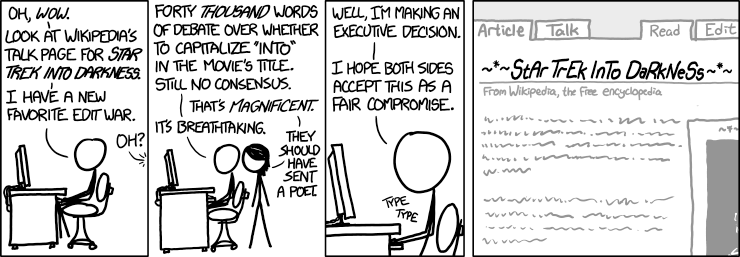 |
| http://imgs.xkcd.com/comics/star_trek_into_darkness.png |
And for them I'm sure it is a 5-star movie. But I bet most of them haven't seen Kurosawa's Seven Samurai (The Criterion Collection), the mother of all action movies, or Preston Sturges' Sullivan's Travels, or possibly the scariest of all action movies, Das Boot, or the sublime Spirited Away, or...thousands of other great movies.
That said, my spouse and I have seen all the Star Trek TV series and movies--along with Galaxy Quest, the very funny sendup of both Star Trek and its cast and its most avid fans. We've also seen all the Star Wars movies. And TV series like FarScape, Babylon 5, Battlestar Galactica, Continuum, Lexx (the most un-Star Trekish of all TV scifi series), Game of Thrones, Vikings, everything Joss Whedon has ever helmed...so we are big fans of scifi/fantasy stuff.
My spouse & I saw Star Trek/Into Darkness last night at the local cineplex in 2D from ideal seats. And both as Star Trek fans (though not superfans) and as movie buffs, we were underwhelmed. Wasn't bad, wasn't great, wasn't memorable.
A fair comparison would be with Joss Whedon's Marvel's The Avengers. Avengers delivered all the popcorn thrills & chills that STID does, but with much more memorable characters, screenwriting, mise en scene, AND without stealing most of its ideas from other movies.
In a way you'd be best off seeing STID if you hadn't seen any Star Trek movies or TV episodes, because this is big budget fan fiction, full of references, characters, and even plotlines from other movies--mostly Star Trek, but at least one action sequence from Star Wars. I'm not griping about Kirk/Spock/Uhuru/Scotty/Doc being there. I'm griping about the movie rehashing old Star Trek shows instead of giving us something new and worthy of a series reboot.
On the plus side, we get Benedict Cumberbatch, the imposing Brit who stars in BBC's modern day retelling of Sherlock Holmes. When he's onscreen the other characters become kind of transparent (metaphorically speaking). And STID's casting is OK. Chris Pine's Cap'n Kirk certainly inhabits the uniform with the same bravado (and less hamminess) than his predecessor. Good Spock. Zoe Saldana's Lt. Uhuru is an improvement on the original. Less successful were Doc and Scotty.
But the real problem is that experienced Trek viewers have seen this movie before, one way or another. In a country with 310 million people, surely one can cook up an original Star Trek screenplay. Whedon took just as heavy a load of backstory and made an original movie out of it. Abrams has not.
I don't understand why this doesn't bother the Trekkies writing reviews here more than it did. The last straw was weaving the original Star Trek TV show thems music into the thunderous but unmemorable orchestral score for this one, during the closing credits. It was jarringly mismatched to the contemporization of this movie.
Unlike others here, I preferred the first Star Trek series reboot movie with the same main characters. It seemed less derivative and more fresh start-y.
But regardless of whether my spouse and I liked it, should YOU get the DVD and see it?
As I said, if you're a Trekkie completest that's a no-brainer.
If you're a Trekkie-light kinda person like my spouse and me (saw all the previous Trek stuff but don't go to conventions and don't live & breathe it), prrrrobably yes. Just don't get your expectations up too high.
And surprisingly, I think it'll work better on a TV screen than in the theater. I realize this is counterintuitive when it comes to big budget action movies. But JJ Abrams shot it for the TV screen: seems like half the film is count-the-pores extreme close-ups of people's faces. This is fine on a TV screen, which supports close and medium-distance shots best. In the theater--even from our ideal seats--it was sort of invasive. If you're planning on seeing it in a theater, I'd recommend sitting towards the back, contrary to where I'd sit for a movie really designed for the theater.
My favorite scene in Avengers was where Scarlett Johansson's Black Widow is talking to Loki when they have him imprisoned. He doesn't realize she's actually interrogating him to find out what he knows that they need to know. The scene is subtle and rests on Johansson's low-keyed but considerable acting talent. I mention this because there's nothing like this in STID. STID puts everything in bright primary colors. Apparently they didn't have a big enough budget for subtlety.
Another recent big-budget sci-fi blockbuster, Avatar, was not a film my spouse and I carry around in our hearts like we do truly great movies, but overall it was considerably better than Star Trek Into Darkness. More original screenplay, more interesting visuals, more engaging storyline. Except for Benedict Cumberbatch and his character. He was more memorable than his counterpart in Avatar, I admit. He was also more memorable than his counterpart in Avengers. He really has a compelling presence.
Note that I'm not comparing Star Trek Into Darkness with, say, Let Me In, the wonderful American remake of the similarly named Swedish vampire movie, starring an amazing 12 year old Chloe Grace Moretz. Or with the True Grit remake. You could say both those films have different audiences.
But this film's audience--outside diehard Trekkies--is the same as for Avengers and Avatar and other blockbusters that aren't scifi even. Against them, and outside any commitment you might have to the Star Trek franchise, this is just an OK movie. I don't think the cast is to blame for this. It's the director, who just isn't as good a movie director as Cameron or Whedon.
I have more specific complaints but I promised a no-spoilers review, so those must wait. One hint though: Benedict Cumberbatch's character's name doesn't fit him at all. Seems like a minor point, but get enough of them and they start to add up to breaking the fourth wall. At least all the characters play it straight--no nudge nudge wink wink moments in the film. That would have been the kiss of death.
Lastly, though, the movie ends on a SEQUEL COMING SEQUEL COMING note, so if you're planning on seeing the next in the series you'll need to see this so you know what's going on. Just see it on DVD instead of in the theater, with a computer or smart phone handy to tide you over the slow parts...
(you can also see this in Amazon.com's STID reader review section)
Tuesday, June 11, 2013
Tioga Lake--pristine nature

This is a panorama photo I shot of Tioga Lake, from the campground there, at around 2,950m elevation (about 9,650 ft.). The mountain tops are bare because they're above the treeline. The night sky here is beyond spectacular. This is about a 45 minute drive from Tuolumne Meadows in Yosemite Park, at a slightly lower elevation.
Which looks like this in the early fall:

2627m elevation (over 8,600 ft.). Nice campground nearby. No showers, though, but you do get flush toilets. And the biggest alpine meadow in North America.
Saturday, May 4, 2013

Thursday, May 2, 2013
Jackie Evancho--star or burnout in the making?
from the Guardian (UK):

Child geniuses: What happens when they grow up?
...
In 2002, [violinist] Jennifer [Pike], aged 12, became the youngest winner of BBC Young Musician of the Year....
"I'm very serious and very dedicated," she says. "It is like a swan on water: there's a lot of paddling underneath."
Her career has entailed sacrifices: her family did not go on holiday so she could play expensive, top-quality violins and there are many things, from basketball to skiing, she would like to do but can't, for fear of injuring her hands...
Her drive, she says, was her own. "The number of young people I've met with somebody speaking for them, literally forcing them to do this... I am lucky. I have a very inspiring and supportive family." As a child, she always wanted to do more practice and play more; it was she who had to push her teachers. "It's funny, the mentality of England is often, 'Let's just keep everybody at the same level', rather than assisting individual needs."
http://www.guardian.co.uk/lifeandstyle/2010/may/15/child-geniuses-prodigies
Nightmare legends of pushy stage mothers are not without a factual basis. When actor/director Robert Redford was casting the part of an 11 year old girl for his new film "The company you keep" he said in an interview that it seemed like some of the chidrens' mothers thought they were auditioning, not their children. (He wound up casting Jackie Evancho because he said when she was acting she didn't seem to be Acting.)
But of course some geniuses have terrific parents, as Jennifer Pike says she did. Parents who realize the truth of what Blake said centuries ago: "One law for lion and ox is oppression." For children who have some species of genius, a regretted childhood is one that suppressed the full expression of that genius. Genius children are not miniature adults, to be sure. But they aren't "children" in the normal sense of the term, either.
Parents who rise to the challenge of having a genius child are those who carefully navigate between the Scylla of exploitation and the Charybdis of ignoring how different their child is.
Jackie Evancho's genius is that of an entertainer who sings. I don't know whether she's particularly talented in other areas. As a singing entertainer it's easy for specialists in classical voice to overlook the overall effect of her total package on her audiences--or to airily dismiss it as yet another child prodigy/future burnout. Likewise the doyens of pop music ignore her completely--what she is, is invisible to the editors of Rolling Stone magazine and suchlike.
She's not an opera singer, not a pop singer, not a child singer (because she neither sings like a child nor comports herself like one when she's singing--no mugging), not one of those autistic mimics who simply replicate someone else's voice. She is a classical crossover singer, but that's a muzzy category with no established canon. And other CC singers don't have the effect on audiences that she does.
Most of her admirers are not musically sophisticated, though some clearly are--including many of the professional musicians and singers she has performed with (one singer said she was "gobsmacked" by Jackie's performance.
The group that may best grasp what's she's got is other professional entertainers who make their living by standing in front of an audience by themselves (or as a soloist in front of other musicians) and enthralling them. She has performed several times at a charity held for/by Muhammed Ali, with such people comprising most of the audience, and their understanding of what she had was obvious.
It's not just operatic singing that she doesn't and probably can't do. Add to that jazz, rock & roll, Tuvan throat singing, Kabuki accompaniment, coloratura arias...many, many areas. She's a specialist. But within her area of expertise--"classical crossover" she's the best of the lot when compared directly with the adults she competes with for CD sales.
I've played her music for many people without showing them a picture or telling them anything about her. Some were unmoved, but many were thrilled--and had no idea she was the age she is. I did this because of so many music people saying it was just her appearance/age. I have proven to my satisfaction that it is not. It's something she does with her sound that affects many people profoundly.
It's not precisely her pitch sense, her phrasing, her restrained use of portamento (and never to hunt for a high note), her equally restrained vibrato, her buttery tone--though all those are prerequisites.
Whatever the mechanics involved are, her secret is her ability to disappear into the music and take the listener with her. She never shows off. She never appears to be communicating "Look at me sing! Aren't I great?"
That's the sort of self-referencing performing that keeps many a singer with great pipes from reaching the peaks. Jackie seems immune to this kind of anxious narcissism. Probably because her parents are so grounded, from all reports.
To a fan of, say, Frank Sinatra, an opera singer may sound like a congeries of screechy artifices. To a fan of opera, Frank Sinatra may seem like someone whose music is both plebian and kitschy. Each is hearing what the other isn't.
A good way to understand Jackie Evancho is to look at her audience when she's singing, and see how many people have tears streaming down their cheeks. What other singer has that effect on people?
Will she still have this effect when she's 20? I'd say almost certainly, because she does not depend on her extreme youth today when she's in performance--she doesn't affect today's trendy kid attire as Justin Bieber does, nor does she project "cute kid" affectations in performance. Nor are the bulk of her fans people who are in general fans of child singers. Most appear to not have been fans of anyone before she came along, in fact. That's what they report.
As for singing age-appropriate stuff...she never sings anything she isn't comfortable with singing. That, to me, is "age-appropriate." She says in interviews that she has a veto on any song proposed to her, and she doesn't hesitate to exercise it. She's polite but not a pushover. What's appropriate for one person to sing at one point in his or her life could be wildly inappropriate for someone else of the same age.
Anyone who has worked with a lot of children should know this. And as the founder of a school district's gifted student program, I saw this in particular with very bright youth. (I would have set no test for admission to the program--only interest and, after a while, a demonstrated ability to keep up with the rest.)
I can understand why someone with refined tastes wouldn't be interested in classical crossover music. My spouse loves it and I didn't hate it, but never wanted to go to a concert of same until Ms. Evancho came along. This has been reported by many other fans of hers. As a very rough guess I'd say maybe half were pre-existing CC fans. Similarly I'm not interested in Country Western music--except for a small number of exceptional artists. Conversely, I love many operas but find many others to be, for me, rather formalistic.
My point is that exceptional talent transcends genre. How a piece is performed matters--sometimes as much as what the piece is.
For example, my spouse and I recently spent several hours on YouTube (piped through our home theater) listening to the Prelude to Bach's Cello Suite #1 as done by dozens of performers using everything from violincello da spalla to double bass to harp guitar to Baroque cello to modern cello. We were both delighted to find that both of us chose the same rendition as our favorite--by a Taiwanese/Swiss guy I'd never heard of, on a modern cello. And I found his performance and that music as moving as I find Ms. Evancho at her best.
re: her schedule
I’ve flown to Taiwan (where Jackie performed March 22) a fair number of times, as it happens (it’s the best stopover for flights to Indonesia, where my wife & I go for scuba diving). Even from the west coast of the USA it’s a looong flight.
A long flight for us traveling economy class, that is. Jackie, of course, travels first class–the crucial aspect being that her seat folds flat and it’s easy for her to get up and move around the cabin.
I’m not saying it’s a snap to travel long distances even that way, but I know my own EconoClass experience is very different. Actually, once my wife & I flew from Heathrow to SFO Business Class (in exchange for getting bumped), and I almost wish we hadn’t. Because now we know what we’re missing! And that wasn’t even First Class.
Her performance schedule isn’t as arduous as one might think. She has stated that she spends half of her time at home, even without averaging in her family vacations. And it’s spaced out.
And within a given performance she alternates with other perfomers.
And her song selections are all well within her actual maximum range, which is reportedly 3 /12 octaves. Moreover, she’s always miked, never belts or even projects strongly.
So an evening’s miked performance of easy (for her) songs isn’t much like a “heldensoprano” doing, say, Siegfried.
Her father has said his main role with her professionally–besides keeping the exploiters and sycophants at bay–is saying “No” to more performances than she does, and regularly sitting her down–with his wife–and telling her they’re ready to pull the plug on the whole thing if she’d rather resume her former life as an ordinary school child. From all reports they are absolutely in earnest about this. Neither has shown the slightest interest in seeking the spotlight for themselves. Her father has said he didn’t even realize what a great singer she is until he observed her effect on other people.
So I’m reasonably certain that Jackie’s life–and the health of her voice–are both in good hands.
Enough talented kids have been exploited by avaricious, narcissistic parents that it’s reasonable to be on guard for that. It’s just not necessary in this case. They don’t push her–she pushes them. That’s one of the ways extremely gifted children differ from the rest of us–as Jennifer Pike says, it’s in their relentless drive.

Child geniuses: What happens when they grow up?
...
In 2002, [violinist] Jennifer [Pike], aged 12, became the youngest winner of BBC Young Musician of the Year....
"I'm very serious and very dedicated," she says. "It is like a swan on water: there's a lot of paddling underneath."
Her career has entailed sacrifices: her family did not go on holiday so she could play expensive, top-quality violins and there are many things, from basketball to skiing, she would like to do but can't, for fear of injuring her hands...
Her drive, she says, was her own. "The number of young people I've met with somebody speaking for them, literally forcing them to do this... I am lucky. I have a very inspiring and supportive family." As a child, she always wanted to do more practice and play more; it was she who had to push her teachers. "It's funny, the mentality of England is often, 'Let's just keep everybody at the same level', rather than assisting individual needs."
http://www.guardian.co.uk/lifeandstyle/2010/may/15/child-geniuses-prodigies
Nightmare legends of pushy stage mothers are not without a factual basis. When actor/director Robert Redford was casting the part of an 11 year old girl for his new film "The company you keep" he said in an interview that it seemed like some of the chidrens' mothers thought they were auditioning, not their children. (He wound up casting Jackie Evancho because he said when she was acting she didn't seem to be Acting.)
But of course some geniuses have terrific parents, as Jennifer Pike says she did. Parents who realize the truth of what Blake said centuries ago: "One law for lion and ox is oppression." For children who have some species of genius, a regretted childhood is one that suppressed the full expression of that genius. Genius children are not miniature adults, to be sure. But they aren't "children" in the normal sense of the term, either.
Parents who rise to the challenge of having a genius child are those who carefully navigate between the Scylla of exploitation and the Charybdis of ignoring how different their child is.
Jackie Evancho's genius is that of an entertainer who sings. I don't know whether she's particularly talented in other areas. As a singing entertainer it's easy for specialists in classical voice to overlook the overall effect of her total package on her audiences--or to airily dismiss it as yet another child prodigy/future burnout. Likewise the doyens of pop music ignore her completely--what she is, is invisible to the editors of Rolling Stone magazine and suchlike.
She's not an opera singer, not a pop singer, not a child singer (because she neither sings like a child nor comports herself like one when she's singing--no mugging), not one of those autistic mimics who simply replicate someone else's voice. She is a classical crossover singer, but that's a muzzy category with no established canon. And other CC singers don't have the effect on audiences that she does.
Most of her admirers are not musically sophisticated, though some clearly are--including many of the professional musicians and singers she has performed with (one singer said she was "gobsmacked" by Jackie's performance.
The group that may best grasp what's she's got is other professional entertainers who make their living by standing in front of an audience by themselves (or as a soloist in front of other musicians) and enthralling them. She has performed several times at a charity held for/by Muhammed Ali, with such people comprising most of the audience, and their understanding of what she had was obvious.
It's not just operatic singing that she doesn't and probably can't do. Add to that jazz, rock & roll, Tuvan throat singing, Kabuki accompaniment, coloratura arias...many, many areas. She's a specialist. But within her area of expertise--"classical crossover" she's the best of the lot when compared directly with the adults she competes with for CD sales.
I've played her music for many people without showing them a picture or telling them anything about her. Some were unmoved, but many were thrilled--and had no idea she was the age she is. I did this because of so many music people saying it was just her appearance/age. I have proven to my satisfaction that it is not. It's something she does with her sound that affects many people profoundly.
It's not precisely her pitch sense, her phrasing, her restrained use of portamento (and never to hunt for a high note), her equally restrained vibrato, her buttery tone--though all those are prerequisites.
Whatever the mechanics involved are, her secret is her ability to disappear into the music and take the listener with her. She never shows off. She never appears to be communicating "Look at me sing! Aren't I great?"
That's the sort of self-referencing performing that keeps many a singer with great pipes from reaching the peaks. Jackie seems immune to this kind of anxious narcissism. Probably because her parents are so grounded, from all reports.
To a fan of, say, Frank Sinatra, an opera singer may sound like a congeries of screechy artifices. To a fan of opera, Frank Sinatra may seem like someone whose music is both plebian and kitschy. Each is hearing what the other isn't.
A good way to understand Jackie Evancho is to look at her audience when she's singing, and see how many people have tears streaming down their cheeks. What other singer has that effect on people?
Will she still have this effect when she's 20? I'd say almost certainly, because she does not depend on her extreme youth today when she's in performance--she doesn't affect today's trendy kid attire as Justin Bieber does, nor does she project "cute kid" affectations in performance. Nor are the bulk of her fans people who are in general fans of child singers. Most appear to not have been fans of anyone before she came along, in fact. That's what they report.
As for singing age-appropriate stuff...she never sings anything she isn't comfortable with singing. That, to me, is "age-appropriate." She says in interviews that she has a veto on any song proposed to her, and she doesn't hesitate to exercise it. She's polite but not a pushover. What's appropriate for one person to sing at one point in his or her life could be wildly inappropriate for someone else of the same age.
Anyone who has worked with a lot of children should know this. And as the founder of a school district's gifted student program, I saw this in particular with very bright youth. (I would have set no test for admission to the program--only interest and, after a while, a demonstrated ability to keep up with the rest.)
I can understand why someone with refined tastes wouldn't be interested in classical crossover music. My spouse loves it and I didn't hate it, but never wanted to go to a concert of same until Ms. Evancho came along. This has been reported by many other fans of hers. As a very rough guess I'd say maybe half were pre-existing CC fans. Similarly I'm not interested in Country Western music--except for a small number of exceptional artists. Conversely, I love many operas but find many others to be, for me, rather formalistic.
My point is that exceptional talent transcends genre. How a piece is performed matters--sometimes as much as what the piece is.
For example, my spouse and I recently spent several hours on YouTube (piped through our home theater) listening to the Prelude to Bach's Cello Suite #1 as done by dozens of performers using everything from violincello da spalla to double bass to harp guitar to Baroque cello to modern cello. We were both delighted to find that both of us chose the same rendition as our favorite--by a Taiwanese/Swiss guy I'd never heard of, on a modern cello. And I found his performance and that music as moving as I find Ms. Evancho at her best.
re: her schedule
I’ve flown to Taiwan (where Jackie performed March 22) a fair number of times, as it happens (it’s the best stopover for flights to Indonesia, where my wife & I go for scuba diving). Even from the west coast of the USA it’s a looong flight.
A long flight for us traveling economy class, that is. Jackie, of course, travels first class–the crucial aspect being that her seat folds flat and it’s easy for her to get up and move around the cabin.
I’m not saying it’s a snap to travel long distances even that way, but I know my own EconoClass experience is very different. Actually, once my wife & I flew from Heathrow to SFO Business Class (in exchange for getting bumped), and I almost wish we hadn’t. Because now we know what we’re missing! And that wasn’t even First Class.
Her performance schedule isn’t as arduous as one might think. She has stated that she spends half of her time at home, even without averaging in her family vacations. And it’s spaced out.
And within a given performance she alternates with other perfomers.
And her song selections are all well within her actual maximum range, which is reportedly 3 /12 octaves. Moreover, she’s always miked, never belts or even projects strongly.
So an evening’s miked performance of easy (for her) songs isn’t much like a “heldensoprano” doing, say, Siegfried.
Her father has said his main role with her professionally–besides keeping the exploiters and sycophants at bay–is saying “No” to more performances than she does, and regularly sitting her down–with his wife–and telling her they’re ready to pull the plug on the whole thing if she’d rather resume her former life as an ordinary school child. From all reports they are absolutely in earnest about this. Neither has shown the slightest interest in seeking the spotlight for themselves. Her father has said he didn’t even realize what a great singer she is until he observed her effect on other people.
So I’m reasonably certain that Jackie’s life–and the health of her voice–are both in good hands.
Enough talented kids have been exploited by avaricious, narcissistic parents that it’s reasonable to be on guard for that. It’s just not necessary in this case. They don’t push her–she pushes them. That’s one of the ways extremely gifted children differ from the rest of us–as Jennifer Pike says, it’s in their relentless drive.
Monday, April 8, 2013
Vikings on the History Channel--true or false?

An article on LiveScience discusses the academics' debate about the History Channel's scripted drama Vikings. My comment:
Both the article and the comments illuminate a philosophical dialog between science's Lumpers and Splitters. As should be obvious, Splitters obsess about the differences between things, Lumpers about the similarities. The article's author is making a Lumper argument.
As a Lumper myself. I'd ask the Splitters here: what difference do the differences make?
To me what would be the most problematic would be if the behavior of the Vikings in the show differed considerably from that of the real deal.
So for example in the sword & sandals Hollywood epics of the 50s, the women all wore modern hairdos and acted like 50s American women--to the point of laughability. I don't see anything so anachronistic here.
The biggest question to me is the shield maiden thing. I don't see absolute proof one way or another, though I'm a bit doubtful about them going raiding. At the same time the protagonist Ragnar is presented as a radical innovator, and his wife as well. So if anyone were going to kick over the traces it would be them.
Also, Christian mores had not yet come to Viking country, and it's conceivable to me that the extreme strictures imposed on women by Medieval Christian culture were not found in the earlier Viking culture.
I agree with the author of the article that there is an overall tipping point with docudramas, beyond which the show becomes unwatchable to anyone with a scientific background--even for us Lumpers. All the Chariots of the Gods nonsense, for example.
I submit that this show is far, far from such a tipping point. And on the level of human motivations, a chieftan hanging on to his power by all means fair or foul isn't just plausible--it's a given. Ditto the ways in which a tribe's smartest warrior could be pushed to take on the Big Dog.
Where I really get off the boat is when the Dickensian coincidences pile up, the motivations look like thin excuses to get us to the next fight scene or special effects event, or look like the screenwriters are just stirring the pot for the sake of stirring the pot. Or everyone's voice sounds like one person's voice. I find none of that here, so on the level of personal character-driven drama I find Vikings believable.
So I find myself in agreement with the NYTimes article about the series.
Monday, March 4, 2013
Water Lillies--no-spoilers review of this 2008 French film

That's what I'll try to do here.
First some filters: this is an organically-paced film in French, with subtitles, shot on a low budget. So if you demand that everything you see look like a glossy Hollywood spectacular, skip "Water Lilies." Even the landscapes aren't gorgeous. This is the Paris of sprawling anonymous suburbs. I'm not sure the characters have even seen the Eiffel Tower... except on TV.
And skip it if you're looking for French porn shot from a middle-aged male point of view (Louis Malle comes to mind). There's nudity here but it's painful, not titillating. There's powerful romantic passion but not the kind of elaborately choreographed love scenes that pass for "sexy" in Hollywood.
Also skip it if you're looking for a lesbian film. It's not about the lesbian community. It's not about a teen discovering she's lesbian and dealing with family and friends who are horrified, yada yada. None of that. There is at least one lesbian in the film, but that doesn't make it a lesbian film, any more than the presence of a black guy in a leading role in "The Matrix" made it a "black film." Lesbianism isn't the subject of "Wild Lilies."
Moreover, skip it if you don't want to see how three fifteen-year old girls see the world. This is what led to one singularly dense reviewer calling this a man-hating film. Well, duh. Imagine what boys are like from a fifteen year old girl's perspective. Girls mature emotionally before boys do, by and large. Boys don't catch up until they're in their 20s (if ever, some might add). The boys' preoccupation with getting laid, coupled with their emotional tone-deafness, makes them seem just like they're presented in this movie. If you're a man reading this, think back. You were like that then, weren't you? Be honest. Aren't you embarrassed by how you behaved during your first years of dating? I know I am.
Lastly, skip it if you want to cling to the belief that teenagers live strictly within the boundaries of a Disney teen comedy like, say, "Freaky Friday." I don't want to give away the plot, so I won't get into specifics like some other reviewers do, but some of the stuff these teens do will make you sit back and go "Whoa..."
But in retrospect it all makes sense--especially since these three teens are all outsiders: the girl boys lust after but who girls hate/despise; the overweight girl desperate for love; and the central figure, a skinny girl (think Scarlett Johansson without the curves) with the passionate depth of Juliet without any of Juliet's Shakespearian articulacy--and whose Romeo is ambivalent about her.
Hollywood screenwriters love the sound of their own words (with some exceptions, like Clint Eastwood), and their screen teens jabber incessantly, usually with the language and obsessions of a middle-aged male screenwriter ("Dawson's Creek"). But "Water Lilies"' teens talk in monosyllables, like many teens do.
And Hollywood teen actors grin and grimace and in general emote the paint off the walls. "Wild Lilies"'s teens look at the world through hooded eyes, with guarded expressions, never revealing more of what's going on inside than they have to.
This looks like non-acting to those accustomed to seeing people sawing the air with their hands and chewing the scenery. To watch this movie you have to recalibrate your head so you can watch people acting like people really act.
Do that, though, and you'll be rewarded richly. Pauline Acquart, who plays the movie's central figure Marie, is in nearly every scene; the movie rests on her narrow shoulders. As I said, she gives away nothing she doesn't have to. Yet hers is one of the most compelling portrayals I've seen of love so powerful it's nearly self-annihilating. But even then she never blurts out one of those totally phony self-revealing-speeches Hollywood uses to explain a character's motivations.
You have to watch Acquart as closely as she watches everyone around her to pry loose her secrets. And even though her love is probably hopeless, and even though it consumes her, she maintains an admirable, stoic dignity. Her courage is equally formidable. She's not one of those outgoing characters who naturally dominates a room. Nor is she a stalker, because stalkers believe their stalkee feels the same way about them and act accordingly. Marie has no such illusions.
Yet even though she has neither charisma, connections, nor the pseudo-courage of a nutcase, nor great beauty, she builds a connection with the one she wants, sometimes cautiously, sometimes boldly, as the occasion demands. She's an audacious general commanding a ragtag force in a war for someone's heart, and it's both fascinating and touching to watch her campaign evolve.
There's a scene in "Jerry Maguire" in which Renee Zelwegger's character dumps Tom Cruise's character, even though she loves him completely, because she can tell he doesn't love her as intensely as she loves him. Acquart's character, albeit less articulately, shows she's capable of the same kind of decision--even though she also shows that she will do almost anything for her Romeo (who's a female, as it happens, but this Romeo being female is absolutely not the point).
One other thing: this film shows us a few weeks in the lives of these three fifteen year olds. When the film ends, we don't know what "happens" later. That is, nothing is wrapped up with a ribbon tied around it. Nor should you expect the film to do so. These are 15 year olds, for heaven's sake.
Some Greek poet said "Call no man happy until his life is over." Likewise with these girls.
That said, I hope the director makes a sequel, with these same three actors. They've earned it. And they've earned your viewership--if you're worthy of this film.
------------
Note: I posted this review on Amazon in 2008, before I started this blog, & I only just realized I hadn't copied it here. It got 15 comments on Amazon BTW--pretty good for such an obscure (in America at least) film.
Saturday, January 5, 2013
Why we're fans--doesn't matter who we're fans of
This is an anthropological explanation.
We're fans of particular celebrities because of the way we learned the skills we needed when we lived in little hunting and gathering bands for millions of years before adopting agriculture and becoming sessile, about 10,000 years ago.
We learned the skills we needed to know by following and imitating the people in our tribe who were best at a given skill. Everyone in your tribe knew who the best hunter was; the best fisherman; the best rain shelter-builder; the best communicator; the best edible plant-finder; the best water-finder, weather-predictor, etc. etc.
There wasn't much instruction. Mostly we watched and imitated. Kids imitate naturally, without even knowing they're imitating. We get less good at it as adults, but most can still do it.
Now in this society we know consciously how it works, more or less, but our instincts still think we're hunting for food in East Africa's woodlands.
It's hard to figure out who's the best dentist, or ophthalmologist, or auto mechanic, or...
But those jobs didn't exist back in the tribal day. On the other hand, what makes celebrities outstanding is far more obvious--a beautiful singer like Jackie Evancho, a dynamic action movie actor like Tom Cruise, a clear communicator of upbeat female teen angst like Taylor Swift. Or someone whose behavior embodies the ideals of our society, like the celebrities who don't become divas but act kindly and responsibly towards others.
So our instincts kick in. We want to follow the celebrity around and pick up their skills through imitation. We can't--not without getting arrested for stalking--and their skills probably aren't the ones we need to acquire (or that are beyond our ability to acquire). But our instincts still think it's 100,000 years ago, and they're just urging to do what our instincts "understand" is best for us.
Fandom isn't very "useful." But it's very understandable.
We're fans of particular celebrities because of the way we learned the skills we needed when we lived in little hunting and gathering bands for millions of years before adopting agriculture and becoming sessile, about 10,000 years ago.
We learned the skills we needed to know by following and imitating the people in our tribe who were best at a given skill. Everyone in your tribe knew who the best hunter was; the best fisherman; the best rain shelter-builder; the best communicator; the best edible plant-finder; the best water-finder, weather-predictor, etc. etc.
There wasn't much instruction. Mostly we watched and imitated. Kids imitate naturally, without even knowing they're imitating. We get less good at it as adults, but most can still do it.
Now in this society we know consciously how it works, more or less, but our instincts still think we're hunting for food in East Africa's woodlands.
It's hard to figure out who's the best dentist, or ophthalmologist, or auto mechanic, or...
But those jobs didn't exist back in the tribal day. On the other hand, what makes celebrities outstanding is far more obvious--a beautiful singer like Jackie Evancho, a dynamic action movie actor like Tom Cruise, a clear communicator of upbeat female teen angst like Taylor Swift. Or someone whose behavior embodies the ideals of our society, like the celebrities who don't become divas but act kindly and responsibly towards others.
So our instincts kick in. We want to follow the celebrity around and pick up their skills through imitation. We can't--not without getting arrested for stalking--and their skills probably aren't the ones we need to acquire (or that are beyond our ability to acquire). But our instincts still think it's 100,000 years ago, and they're just urging to do what our instincts "understand" is best for us.
Fandom isn't very "useful." But it's very understandable.
Subscribe to:
Posts (Atom)